Coleman 13B vs 17B: An Honest Comparison From a 17B Owner
This post contains Amazon affiliate links. As an Amazon Associate, I earn from qualifying purchases at no extra cost to you.
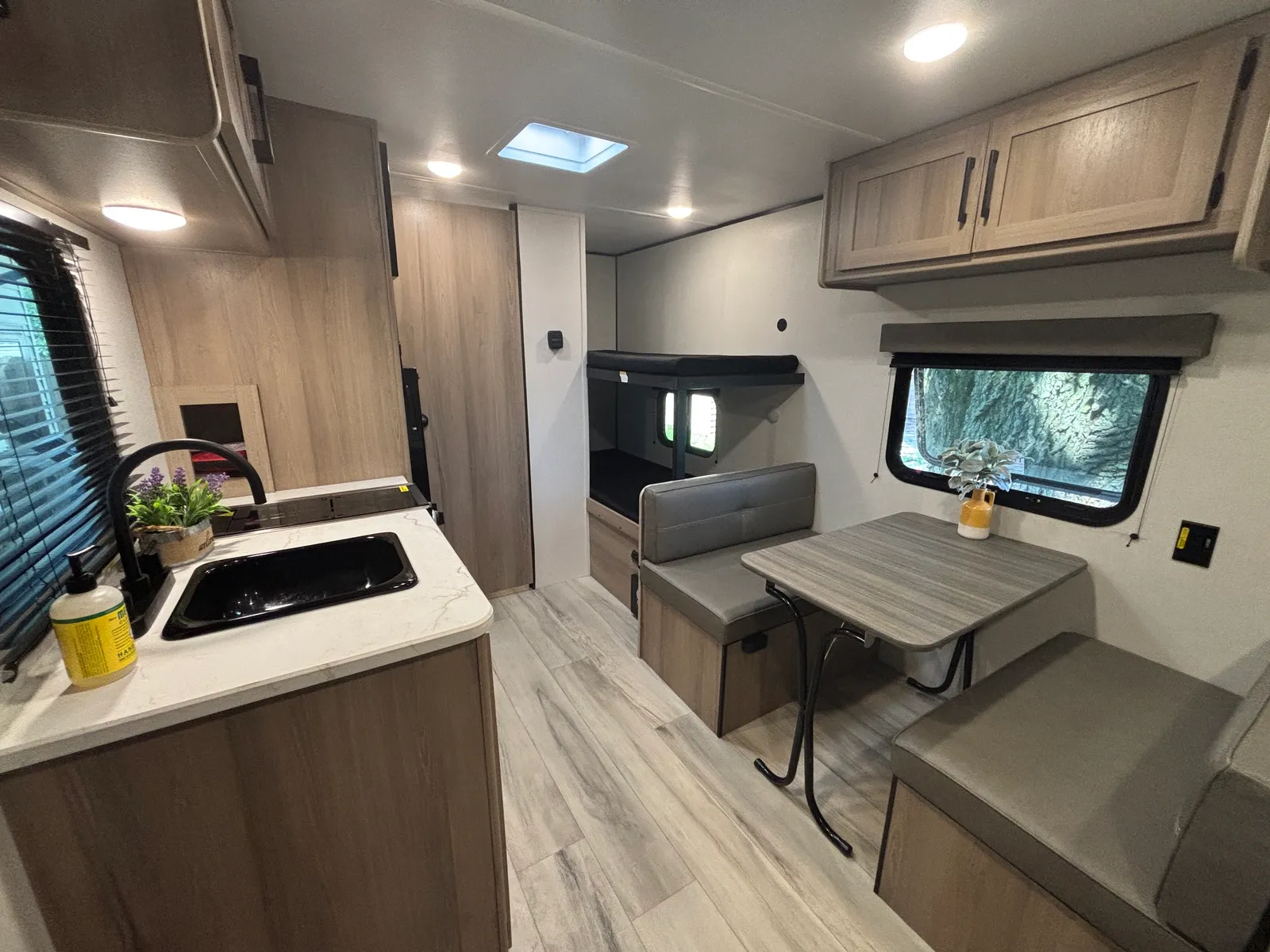
The Coleman 13B and 17B are two of the most searched small travel trailers out there, and for good reason. Both are light, affordable bunkhouse campers from Keystone’s Coleman line. We own a 2025 Coleman 17B and have put 11 trips and over 2,000 miles on it. We have not camped in a 13B, so we will be upfront about that: the 17B notes below come from owning one, and the 13B notes come from the published specs. Here is how they stack up.
In this post
- The quick answer
- Coleman 13B vs 17B specs
- The biggest difference: all-electric vs propane
- Size and towing
- Sleeping
- Kitchen and dining
- Bathroom and water
- Price
- Which one should you buy?
- Upgrades that work on both
- Coleman 13B vs 17B FAQs
The quick answer
The Coleman 13B is the smaller, lighter, all-electric option: about 16 feet, around 2,500 pounds, no propane, and no indoor table. The Coleman 17B is about 20 feet and 3,100 pounds, runs on propane and electric, and adds a booth dinette and a bed for one more person.
- Get the 13B if towing weight and length matter most, you camp with hookups, you are a family of four or less, and you mostly cook and eat outside.
- Get the 17B if you want an inside table, a gas stove and furnace that work without hookups, room for one more sleeper, and a little more breathing room on a rainy day.
Still torn? Take our 5-question Coleman quiz and it will point you to the 13B, 13R, 17B, or 17R.
Just the two of you? Look at the Coleman 13R too. Per Keystone, it is the same 15’11“ length and all-electric setup as the 13B (induction cooktop, 110V fridge, electric fireplace, no propane), but it sleeps 2 instead of 4, at 2,483 pounds dry.
Watch a Coleman 17B walkthrough
Aaron Goes Outdoors walks through a 2025 Coleman 17B inside and out, with a real owner’s take.
Coleman 13B vs 17B specs
These are the current specs from Keystone’s own Coleman 13B and Coleman 17B floorplan pages, with MSRP from RV Guide. Exact numbers can vary by model year and options, so confirm with the dealer on the unit you are looking at.
| Spec | Coleman 13B | Coleman 17B |
|---|---|---|
| Length | 15’11“ | 20’2“ |
| Dry (shipping) weight | 2,506 lbs | 3,071 lbs |
| Cargo capacity | 994 lbs | 1,229 lbs |
| GVWR | 3,500 lbs | 4,300 lbs |
| Hitch weight | 352 lbs | 398 lbs |
| Sleeps | 4 | 5 |
| Beds | Queen and bunks | Queen, bunks, and a dinette that converts |
| Dinette | No | Yes, booth style |
| Propane | None | Yes, 20 lb tank |
| Cooktop | Induction (electric) | 2-burner gas |
| Fridge | 3 cu ft, 110V | 3 cu ft, 12V |
| Heat | Electric fireplace | 20,000 BTU furnace |
| Water heater | Not listed by Keystone | 42,000 BTU tankless |
| Bathroom | Rear, with shower | Rear, with shower |
| Fresh water | 28 gal | 21 gal |
| Gray / black | 34 / 34 gal | 34 / 34 gal |
| Starting MSRP | $13,256 | $16,488 |
The biggest difference: all-electric vs propane
This is the difference most quick comparisons skip. Per Keystone’s spec sheet, the current 13B is all-electric. It has an induction cooktop, a 110V fridge, and an electric fireplace for heat, with no propane tank at all. The 17B has a propane tank, a two-burner gas stove, a 20,000 BTU furnace, a tankless water heater, and a 12V fridge.
Why it matters: the 13B is built for campgrounds with electric hookups. Without shore power or a generator, there is no way to cook, heat, or run the fridge. The 17B can cook, heat, and make hot water on propane, and its fridge runs off the battery, so it can handle a night or two without hookups. If you ever want to camp off grid, that is a big deal. Here is how I am setting up our 17B for off-grid and emergency use.
The upside of all-electric: no propane tanks to fill, swap, or worry about. If you always camp at sites with power, that simplicity is a real plus.
Size and towing
The 13B is about four feet shorter and roughly 565 pounds lighter dry. That opens it up to more mid-size SUVs and smaller trucks, and it is easier to back into tight sites and store in a driveway.
The 17B is still a light trailer. Ours tows easily, and we have taken it about 500 miles each way to Mackinac Island. But if your tow vehicle is on the edge, the 13B gives you more margin. Whichever you pick, check your own vehicle’s tow rating and payload (our towing calculator does the math for you), and remember to budget for a weight distribution hitch if your state requires one. Ours did not come with one. Here is every 17B spec and how we tow ours.
Sleeping
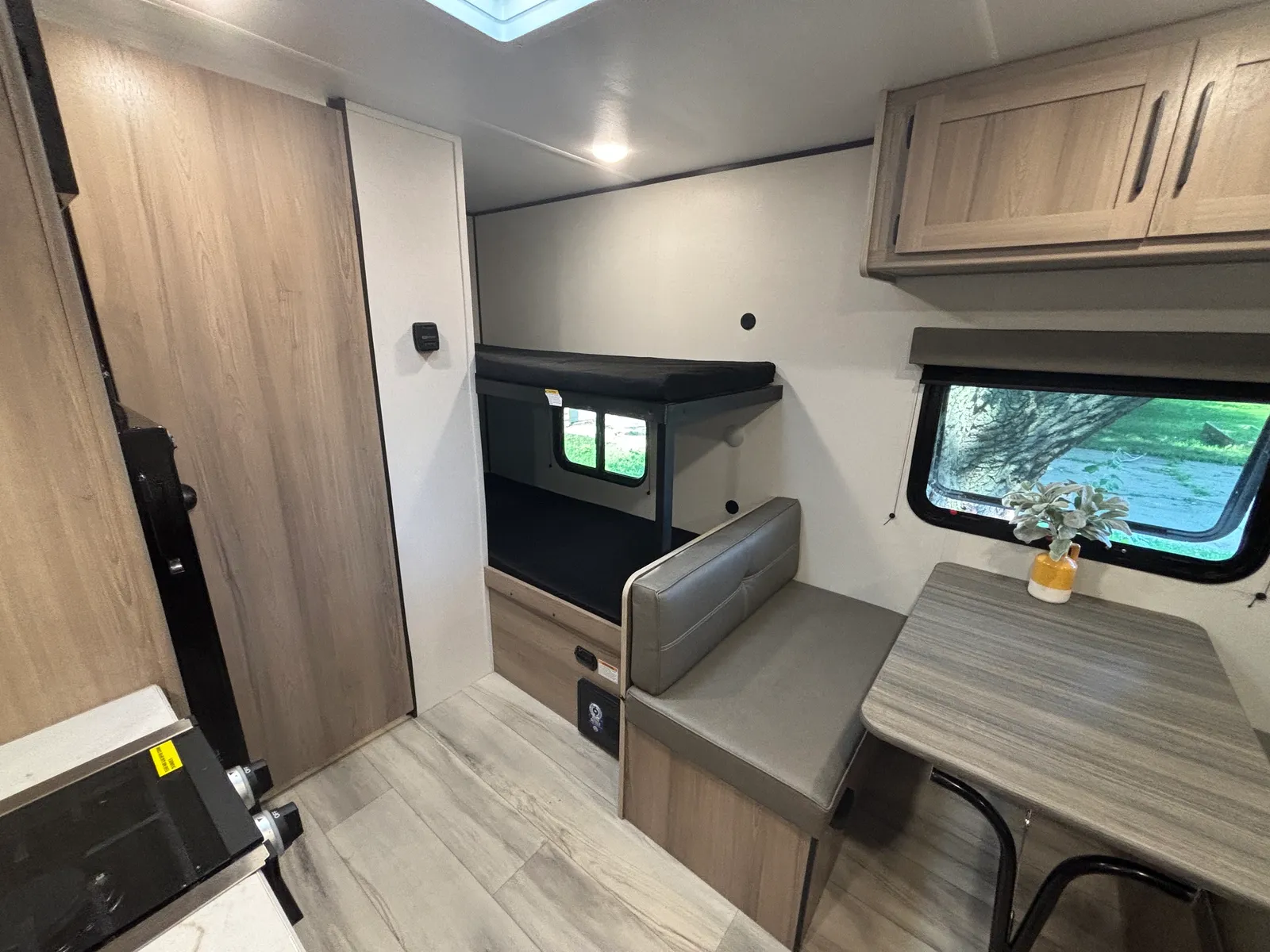
Both have a queen bed up front and bunks in the back. The difference is the dinette. On the 17B, the booth dinette folds down into another sleeping spot, which is why it is rated to sleep more.
From owning the 17B: the bunks are a great use of space, but plan on mattress toppers before anyone sleeps on them. That will almost certainly apply to the 13B bunks too.
Kitchen and dining
This is the difference you will feel most on a rainy day. The 17B has a booth dinette, so you have a real table inside for meals, games, and coffee. Per the specs, the 13B does not have a kitchen table configuration, so plan on eating outside or using a camp table.
The stove is the other gap. The 13B has an electric induction cooktop that needs shore power, while the 17B has a two-burner gas stove that runs on propane. On ours, we swapped the factory burners for a flush two-burner cooktop to get more counter space, and it is one of our favorite upgrades.
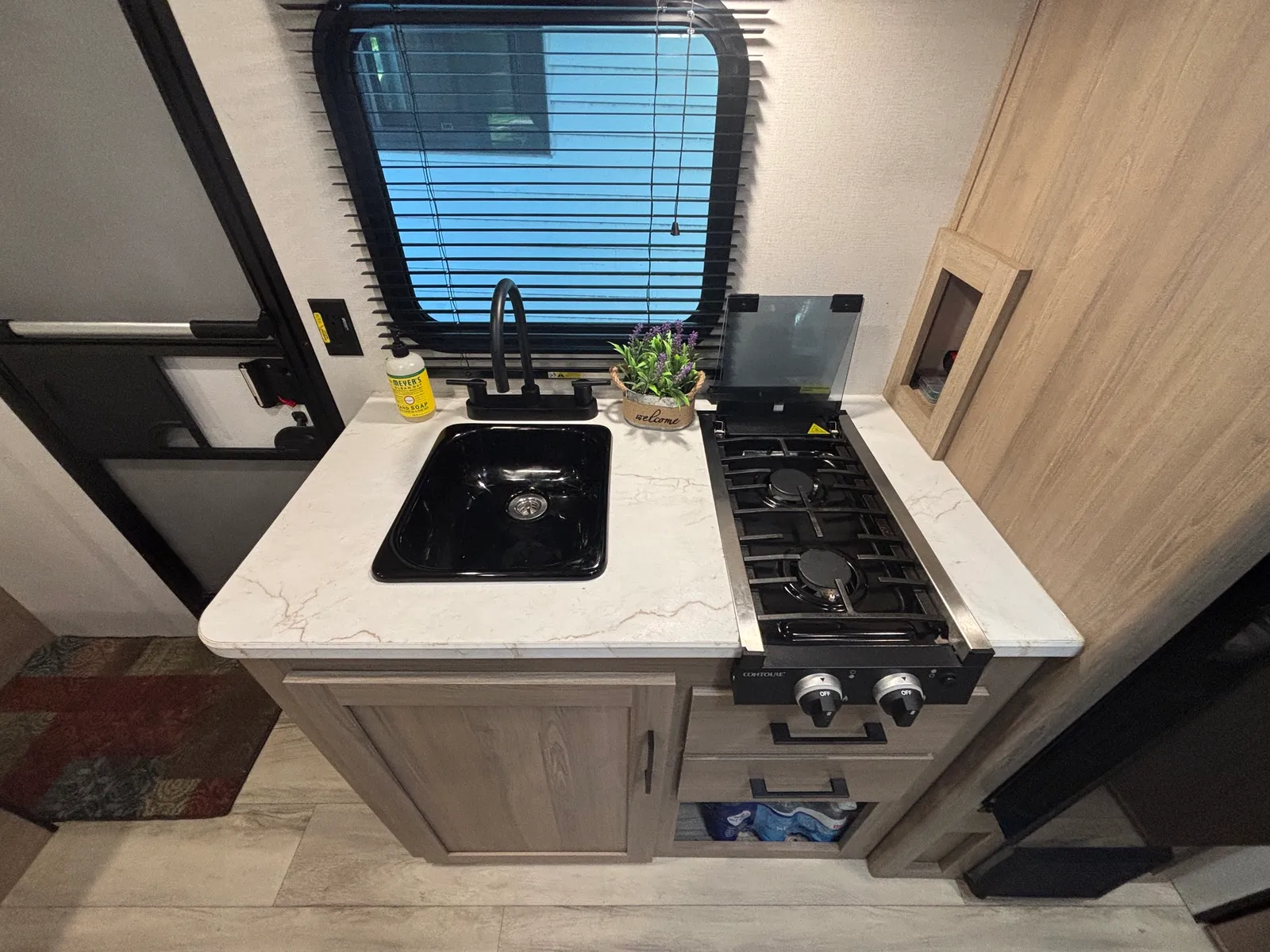
▶ See the 17B kitchen and stove upgrade in the video
Bathroom and water
Both put the bathroom at the rear with a shower. Having a real bathroom in a trailer this small is a big win either way. Interestingly, the 13B is listed with a bigger fresh water tank (28 gallons vs 21), with the same size gray and black tanks. Keystone’s 13B page does not list a water heater, so ask the dealer how hot water works on the exact unit you are looking at.
From owning the 17B: watch the seals around the bathroom vent and the shower. We had a small leak show up early in the bathroom. Here is how we check our Coleman for water leaks.
Price
The 13B starts around $3,000 less by MSRP. Real prices vary a lot by dealer, and both models are often sold well below MSRP. For reference, we paid $13,499 out the door for our 2025 17B. The weight distribution hitch was a separate purchase after that. Shop around, and negotiate the extras in.
Which one should you buy?
Pick the Coleman 13B if:
- Your tow vehicle is smaller, or you want the most margin you can get.
- You are a couple, or a family of three or four with young kids.
- You cook and eat outside most of the time anyway.
- You want the lowest price and the easiest trailer to store.
- You always camp with electric hookups and like skipping propane.
Pick the Coleman 17B if:
- You want an inside table for meals and rainy days.
- You need room for one more sleeper, now or as the kids grow.
- You want a gas stove, furnace, and hot water that work without hookups.
- A few extra feet and a few hundred pounds are not a problem for your tow vehicle.
For our family, the 17B was the right call. The dinette alone earns its keep, and the extra room makes a long weekend easier. But if we had a smaller tow vehicle, the 13B would be the one we would look at hardest.
Upgrades that work on both
Most of what we added to our 17B carries over to the 13B, because the two share a lot of the same Coleman build. Here is what would apply to either:
- Leveling blocks and a water pressure regulator for every setup.
- A spare tire you have actually checked, with the right size and bolt pattern for your trailer.
- Roof lap sealant and a moisture meter to stay ahead of leaks.
- A keyless entry lock, which fits standard RV entry doors. Here is our keyless lock install.
- Shelf bins, a fridge travel strap, and mattress toppers for the bunks.
The full list is in our Coleman camper must-haves, which covers the whole Coleman lineup.
Coleman 13B vs 17B FAQs
What is the difference between the Coleman 13B and 17B?
The 13B is all-electric with no propane, about 16 feet long, and around 2,500 pounds dry, with a queen, bunks, and no dinette. The 17B is about 20 feet and 3,071 pounds, runs on propane and electric, and adds a booth dinette, a gas stove, a furnace, and a bed for one more person.
How long is the Coleman 13B?
15 feet 11 inches, per Keystone.
How much does a Coleman 13B weigh?
Keystone lists a shipping (dry) weight of 2,506 pounds, 994 pounds of cargo capacity, a 352 pound hitch weight, and a 3,500 pound GVWR.
Does the Coleman 13B have propane?
No. The current 13B is all-electric. It has an induction cooktop, a 110V fridge, and an electric fireplace, with no propane tank. The 17B has propane for the stove, furnace, and water heater.
Can you camp off grid in a Coleman 13B?
Not easily. Because it is all-electric, the 13B needs shore power or a generator to cook, heat, and run the fridge. The 17B handles a night or two without hookups much better.
How many people does the Coleman 13B sleep?
Four, with a queen bed and bunks. The 17B sleeps five because its dinette converts into another bed.
Does the Coleman 13B have a bathroom?
Yes. Per the published specs, it has a rear bathroom with a toilet and a shower.
Is the Coleman 17B worth the extra money over the 13B?
For us, yes, mostly for the inside dinette and the extra room. If you need the lightest trailer you can get, or you cook outside anyway, the 13B is a great value.
Final thoughts
You cannot really go wrong with either one. The 13B is the lighter, cheaper, easier-to-tow option. The 17B gives you a real table, two burners, and room to grow. Decide based on your tow vehicle and how much time you spend inside, and you will be happy with either.
Want to try a small Coleman before you buy? You can rent our Coleman 17B here in Cedar Falls and see the layout for yourself. For the long-term take, read our one-year Coleman 17B review, and for more Coleman content, subscribe to Aaron Goes Outdoors on YouTube.